The best surf fishing spots on the Outer Banks are Cape Point at Buxton, Oregon Inlet, Hatteras Inlet and Ocracoke’s South Point, all reached by 4x4 through the Cape Hatteras National Seashore ramps. Without a truck, the six ocean piers and the walk-on beaches from Corolla to Nags Head, Coquina Beach and the Hatteras village beaches put you on the same fish.
Checking conditions for a particular spot? There is now a report page for each pier and town — the list is here, each one with live water temperature, wind and tide.
The Outer Banks runs about 130 miles from the Virginia line down to Ocracoke Inlet, and almost every mile of it holds surf-fishable water. “Fish anywhere” is not useful advice, though, when you’ve got one week of vacation and you want to actually catch something. This is the index — the major spots, what each one does, and what to expect.
Corolla to Ocracoke
The Outer Banks Surf Fishing Map
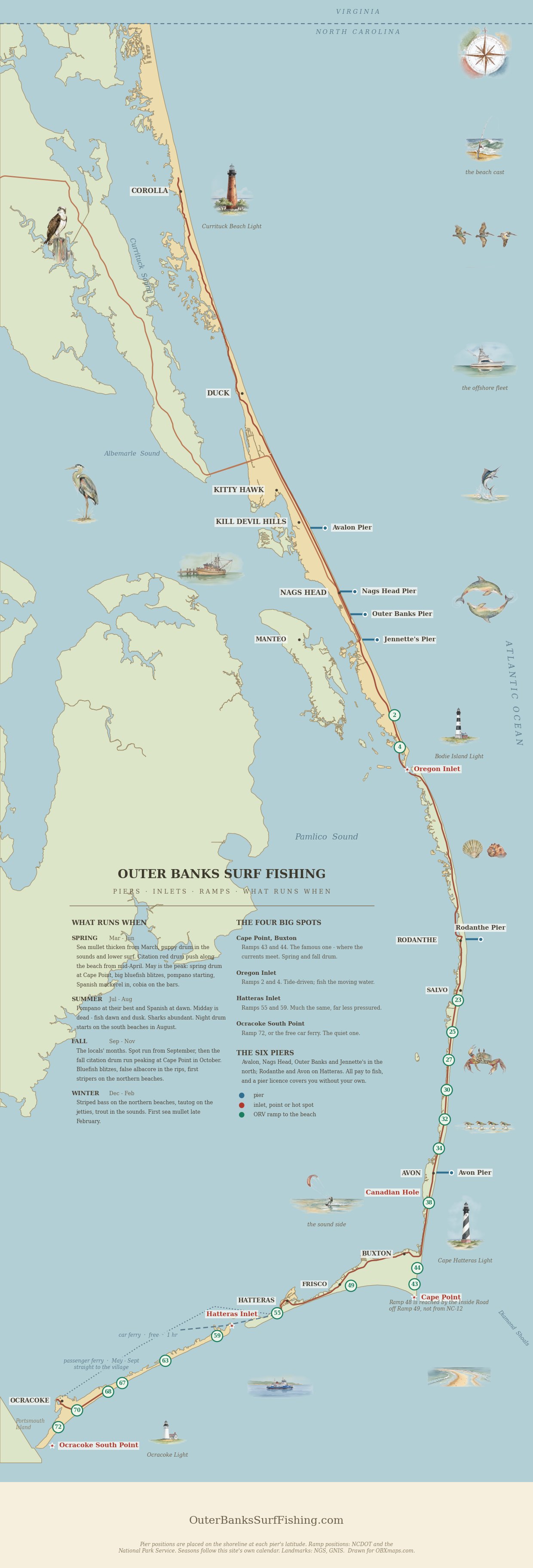
Every ocean pier, the four big spots and all twenty designated ORV ramps that reach the ocean beach — plus what runs when. Tap anything on the map to jump to its guide.
Or pick a spot from the list
- How to surf fish the Outer Banks
- Surf conditions
- The Outer Banks fishing report
- What you can catch
- Shelling the Outer Banks
- Avon and Canadian Hole
- Cape Hatteras surf fishing
- The Hatteras to Ocracoke ferry
- Currituck Beach Lighthouse
- Ocracoke Island
- Avalon Pier
- Ramp 2
- Ramp 4
- Ramp 23
- Ramp 25
- Ramp 27
- Ramp 30
- Ramp 32
- Ramp 34
- Ramp 38
- Ramp 44
- Ramp 43
- Ramp 48
- Ramp 49
- Ramp 55
- Ramp 59
- Ramp 63
- Ramp 67
- Ramp 68
- Ramp 70
- Ramp 72
- Oregon Inlet
- Hatteras Inlet
- Canadian Hole
- The month-by-month calendar


The Geography in Three Pieces
- The northern beaches (Corolla, Duck, Southern Shores, Kitty Hawk, Kill Devil Hills, Nags Head, South Nags Head): Family beaches, hotels, rentals. Town-managed. Beach driving restricted in summer. Piers are here. Easier access, more crowded.
- Hatteras Island (Rodanthe, Waves, Salvo, Avon, Buxton, Frisco, Hatteras Village): National Seashore. ORV permit territory. Cape Point, the inlets. Wilder, less developed, the heart of OBX surf fishing. See the full Cape Hatteras surf fishing guide for spots, species and seasons.
- Ocracoke Island (ferry-only access from Hatteras or Cedar Island): The quietest. Long stretches of undeveloped beach. Worth the ferry.
The four big spots
- Cape Point — The most famous surf-fishing spot on the East Coast. Spring and fall citation drum, summer Spanish and blues, year-round drama. Full guide.
- Oregon Inlet (south side and the catwalk) — Tide-driven, big-fish, accessible by truck or by walking the bridge catwalk.
- Hatteras Inlet (north side, Ramps 55 and 59) — Similar inlet dynamic to Oregon, less pressured.
- Ocracoke South Point — The quietest of the inlet spots. Ferry over, fish all day.
The Piers
Piers are the simplest way to fish the OBX without learning the surf-fishing learning curve. No separate license needed while fishing from the pier deck — the pier’s blanket license covers you there (step onto the beach or into the surf and you need your own CRFL). A few sound-side piers don’t carry the blanket license, so ask at the pier house. Tackle rental on site. Family-friendly. Full pier guide.
- Jennette’s Pier (Nags Head) — The flagship. Concrete, NC Aquarium-operated.
- Avalon Pier (Kill Devil Hills) — Classic wooden pier.
- Nags Head Pier — Whalebone Junction area.
- Outer Banks Fishing Pier (Nags Head) — Southernmost of the Nags Head trio.
- Rodanthe Pier — Hatteras Island’s surviving pier.
- Avon Pier — Working-class pier, locals’ choice.
No 4x4? Where to surf fish on foot
Most of the coast is a walk-on. The northern towns have public beach accesses along the beach road, most of them in Kitty Hawk, Kill Devil Hills and Nags Head: park at the access, walk over the dune, and fish the slough in front of you. Coquina Beach on Bodie Island has two parking lots, a bathhouse and a boardwalk to the sand, with Ramp 4 next door. On Hatteras Island the villages have walk-over accesses at the ends of the side streets, the Seashore has day-use lots at Frisco and at the old lighthouse site in Buxton, and the Buxton lot is a long walk from the Point. Ocracoke’s lifeguarded day-use beach north of the village is a walk-on too.
The fish do not know where the pavement ends. Sea mullet, spot, pompano, bluefish and puppy drum run the whole beach; the points and inlets concentrate the big drum and the inlet fish, and that is what the 4x4 is for. Guides for the walk-on stretches: Duck, Kitty Hawk and the northern beaches and Corolla.
The ORV Ramp Map
If you have an NPS ORV permit, the entire beach is accessible by ramp. The ramps fishermen care about most:

- Ramp 4 (Coquina Beach) — Easy access, family-friendly.
- Ramps 23 and 27 (Salvo) — Less crowded, good slough fishing. The Hatteras Island RV parks cluster nearby in Rodanthe, Waves and Salvo.
- Ramps 30, 34, 38 (Avon) — Solid summer fishing.
- Ramps 43 and 44 (Cape Point) — Gateway to the famous one. Camping at Cape Point Campground puts you minutes from the ramp for first-light tides.
- Ramps 48 and 49 (Frisco) — Underrated for pompano and sea mullet.
- Ramps 55 and 59 (Hatteras Inlet) — Inlet-edge big-fish water.
- Ramps 67, 70, 72 (Ocracoke) — Quietest of the OBX.
Individual ramp pages with typical species, parking notes, and current closure status are linked from each.
Flying in, or driving something that can’t go on the sand?
Beach4x4 — our rental company, based in Kill Devil Hills — rents beach-ready 4WD Jeeps and SUVs for the ORV ramps, with the beach permit already on the windshield and the required recovery gear in the back. See what’s available →
Sound vs. Surf
When the wind is wrong for the ocean — usually SW or S — the sound side is the play. The Pamlico and Roanoke sounds hold puppy drum, speckled trout, flounder, and the occasional striped bass. Less dramatic than the surf, but you can fish protected water and still catch a cooler.

- Avon sound side — protected water, good for sight-fishing puppy drum on a falling tide.
- Salvo / Waves sound side — kite-surfing spots double as fishing spots.
- Hatteras Inlet sound side — strong current edges, real big-fish potential.
- Oregon Inlet sound side — the catwalk and the back side.
Spots by season
- Spring (April–May): Cape Point and the Buxton-to-Frisco ramps (43, 44, 49) for the citation drum run; sea mullet on every beach, so the piers and the town beaches fish too.
- Summer (June–August): the piers for Spanish mackerel, bluefish and deeper water; the Frisco ramps (48, 49) and any slough for pompano at first light; the south beaches and Cape Point at night for drum.
- Fall (September–November): the September spot run on the northern beaches and piers; the October drum run at Cape Point (Ramps 43 and 44), with Oregon Inlet and Hatteras Inlet for the inlet bite; November stripers on the northern beaches from Nags Head to Corolla.
- Winter (December–March): striped bass from Duck to Corolla on calm days, tautog on the jetty rocks at Oregon Inlet, and the sound side when the ocean is blown out.
The month-by-month calendar has the water temperatures and the species for each month.
How to Choose for Your Trip
- Family vacation, no truck, want to catch fish: A pier (Jennette’s is easiest).
- Family vacation, have a truck and ORV permit: Coquina Beach, Ramps 23-27 (Salvo), or Ramps 48-49 (Frisco).
- Serious about citation drum: Cape Point, Oregon Inlet, Hatteras Inlet.
- Bad wind on the ocean: Sound side.
- Want solitude: Ocracoke.